
Technology Landscape.
Choose What Powers Your Systems. With Clarity.
Technology decisions define how systems perform, scale, and evolve. A structured landscape ensures every choice aligns with long-term direction.
The Challenge is Not Technology. It's Choice.
Multiple tools, platforms, and frameworks exist across every layer. Clarity comes from knowing what fits—not just what is available. Every decision has a layer. Technology is not selected in isolation. Each choice connects to how systems are built, integrated, and scaled.
- Technology decisions define how systems perform, scale, and evolve.
- A structured landscape ensures every choice aligns with long-term direction.
- Clarity comes from knowing what fits—not just what is available.
- Each choice connects to how systems are built, integrated, and scaled.
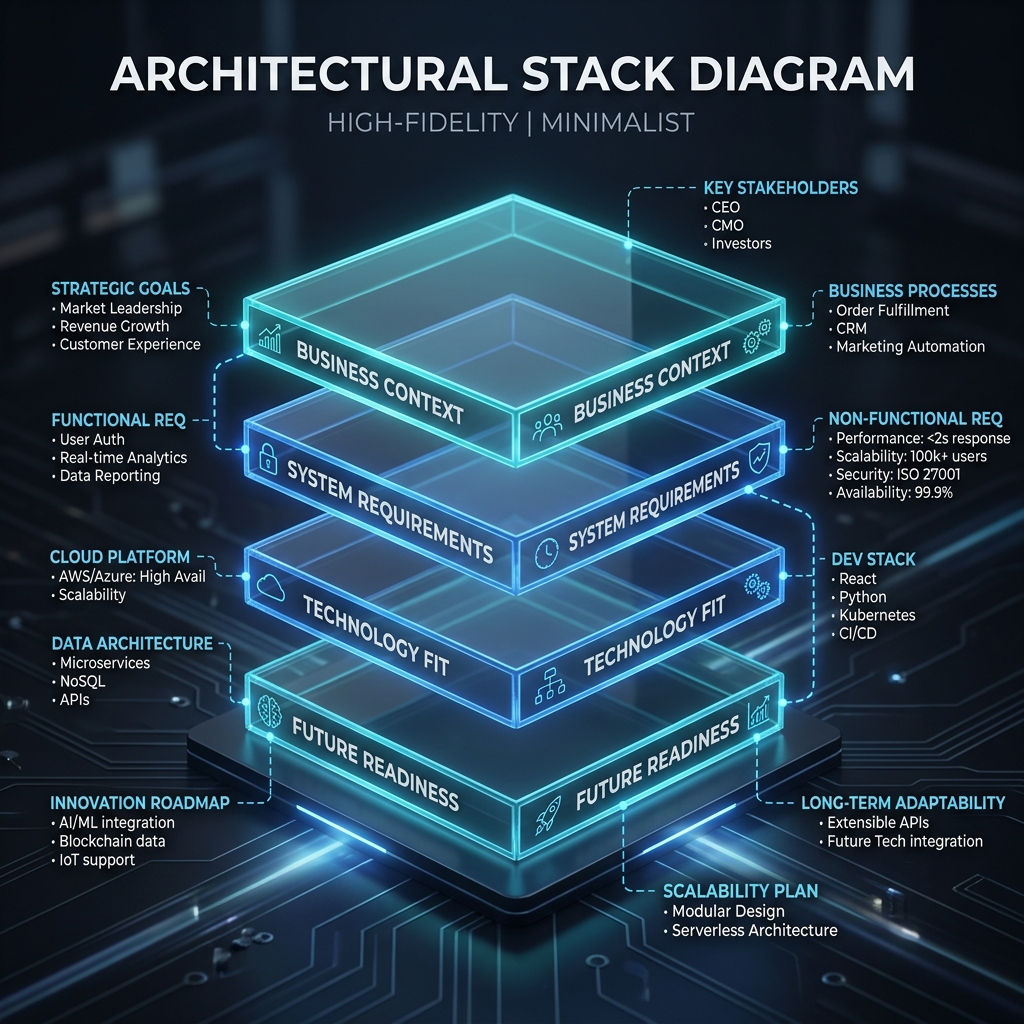
How Decisions Are Structured
Technology decisions define how systems perform, scale, and evolve. A structured landscape ensures every choice aligns with long-term direction.
Business Context
What the system needs to achieve across users and operations. Defines direction before technology is considered.
System Requirements
Scale, performance, integrations, and workflows. Shapes how the system needs to behave.
Technology Fit
Tools and platforms that align with requirements and constraints. Ensures compatibility and long-term usability.
Future Readiness
Ability to evolve with growth, change, and new capabilities. Ensures the system remains adaptable over time.
Technology Landscape Layers
Experience Layer
Frontend technologies that define how users interact with systems. Focus on usability, responsiveness, and consistency.
Application Layer
Backend systems that handle business logic and workflows. Ensure scalability, performance, and structure.
Data Layer
Databases, warehouses, and processing systems. Enable storage, analytics, and reliable data flow.
Integration Layer
APIs, services, and communication systems. Connect applications across platforms and environments.
Infrastructure Layer
Cloud, compute, and environments where systems operate. Support performance, availability, and scale.

Designed for Modern Ecosystems
Technology landscapes span across platforms, services, and environments. Clarity ensures systems remain connected and aligned across every layer of the enterprise.
Cloud platforms
Distributed compute and environment orchestration.
Data systems
Unified storage and high-speed processing engines.
Integration layers
Real-time communication and service connectivity.
Application frameworks
Modern structures for building resilient systems.
Clarity in Every Decision
A structured technology landscape provides the foundation for sustainable growth, operational efficiency, and architectural integrity.

Aligned Technology Stack
All components work together as a unified system.
- Reduce fragmentation
- Eliminate complexity
- Cross-layer compatibility

Long-Term Maintainability
Systems remain structured and easy to evolve.
- Avoid constant rework
- System instability protection
- Simplified updates

Scalable Foundations
Technology supports growth across users and workloads.
- Performance consistency
- Adaptive infrastructure
- Load management

Faster Decision-Making
Clear evaluation reduces delays in choosing tools.
- Confidence in choice
- Accelerated timelines
- Reduced evaluation lag
From Options to Direction.
How the Landscape is Defined. A structured approach to selecting and standardizing your technology stack.
Identify Use Cases
Understand system support across functions. Define real-world requirements for long-term clarity.
Map Technology Categories
Structure tech across frontend and data layers. Create clarity across all system components.
Evaluate Fit and Alignment
Assess tools for scale and ecosystem support. Ensure alignment with business and system needs.
Define the Stack
Select technologies that work as a unified system. Avoid fragmentation across architecture layers.
Standardize for Consistency
Establish patterns and standards across teams. Ensure long-term maintainability and system clarity.
Make Decisions That Last.
Define your technology landscape with clarity and structure. Ensure every decision supports performance, scalability, and evolution.